
Recurring Conflict
Different subjects repeatedly lead to a familiar interaction or outcome.
What looks like one difficult conversation may be part of a larger pattern shaping connection, trust, communication and relational stability.
Project SPICES™ provides a systems-level lens for understanding how alignment influences the way people connect, respond under pressure and move through recurring relational challenges.
Relationships are shaped by more than the topic being discussed in a single moment.
Communication, pressure, expectations, boundaries, trust, capacity, history and patterns of response can interact in ways that influence how people experience one another.
Project SPICES™ approaches relational challenges through the same systems-level principle that guides the broader architecture: what becomes visible may be the output of a larger interconnected system.
Relational strain can appear in many forms. The visible issue matters—but it may not tell the entire story.
Different subjects repeatedly lead to a familiar interaction or outcome.
Conversations become harder to navigate when pressure, interpretation or reactivity rises.
Disconnection may grow when repeated interactions leave one or both people feeling unheard or uncertain.
Expectations, limits, roles and responsibilities can become unclear or difficult to negotiate.
Stress outside the relationship can influence how people communicate and respond inside it.
Repeated strain can affect the sense of steadiness, predictability and connection between people.
Money. Chores. Parenting. Intimacy. A comment. A tone.
The subjects may genuinely matter. But when very different subjects repeatedly produce a similar interaction, another question becomes useful:
What pattern is operating underneath the changing topic?
A systems lens does not dismiss the immediate issue. It expands the field of view so recurring interaction, pressure, capacity and context can also be considered.
Project SPICES™ helps frame relational challenges within a broader human context without reducing complex experiences to a single behavior or label.
Identify where strain, disconnection or recurring difficulty is showing up.
Consider the broader conditions and patterns influencing the interaction.
Move toward context-specific education, coaching or another appropriate form of support.
Project SPICES™ communicates the systems-level lens and application context while its internal assessment, mappings and Re+Calibration™ methodology remain proprietary.
Communication matters. So do the conditions surrounding communication. Relational functioning can be influenced by several interconnected areas at once.
Recognizing one's own responses, assumptions, pressure and patterns.
Expressing needs, concerns and meaning with greater clarity and intention.
Building greater consistency, reliability and relational safety over time.
Clarifying limits, expectations, responsibilities and respectful interaction.
Understanding how stress, fatigue and competing demands affect interaction.
Developing ways to recover after difficult interactions and move forward deliberately.
Project SPICES™ provides the foundational systems lens. Relational learning is delivered through focused properties and experiences designed specifically for relationship contexts.
One focused learning experience within the relational ecosystem addresses recurring conflict patterns directly.

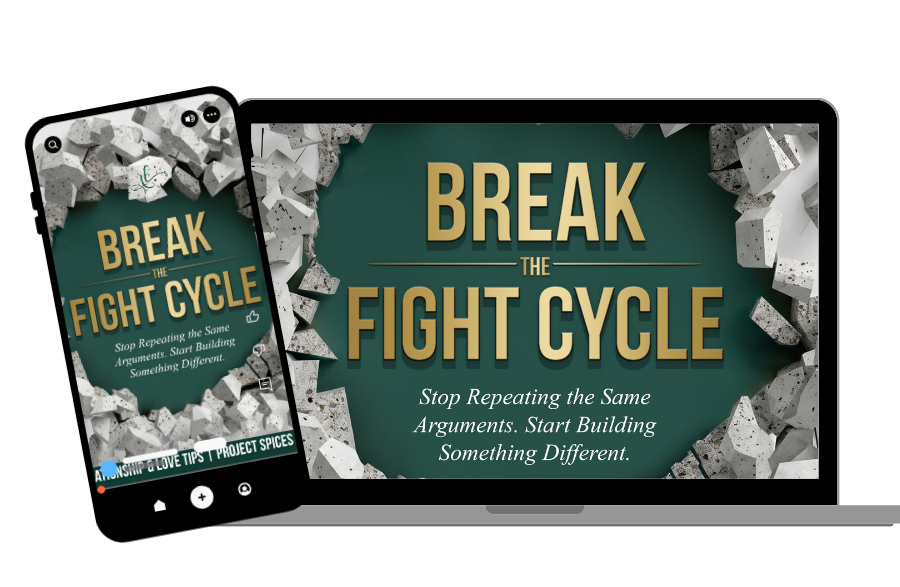
Private, self-paced relationship education for recurring conflict patterns.
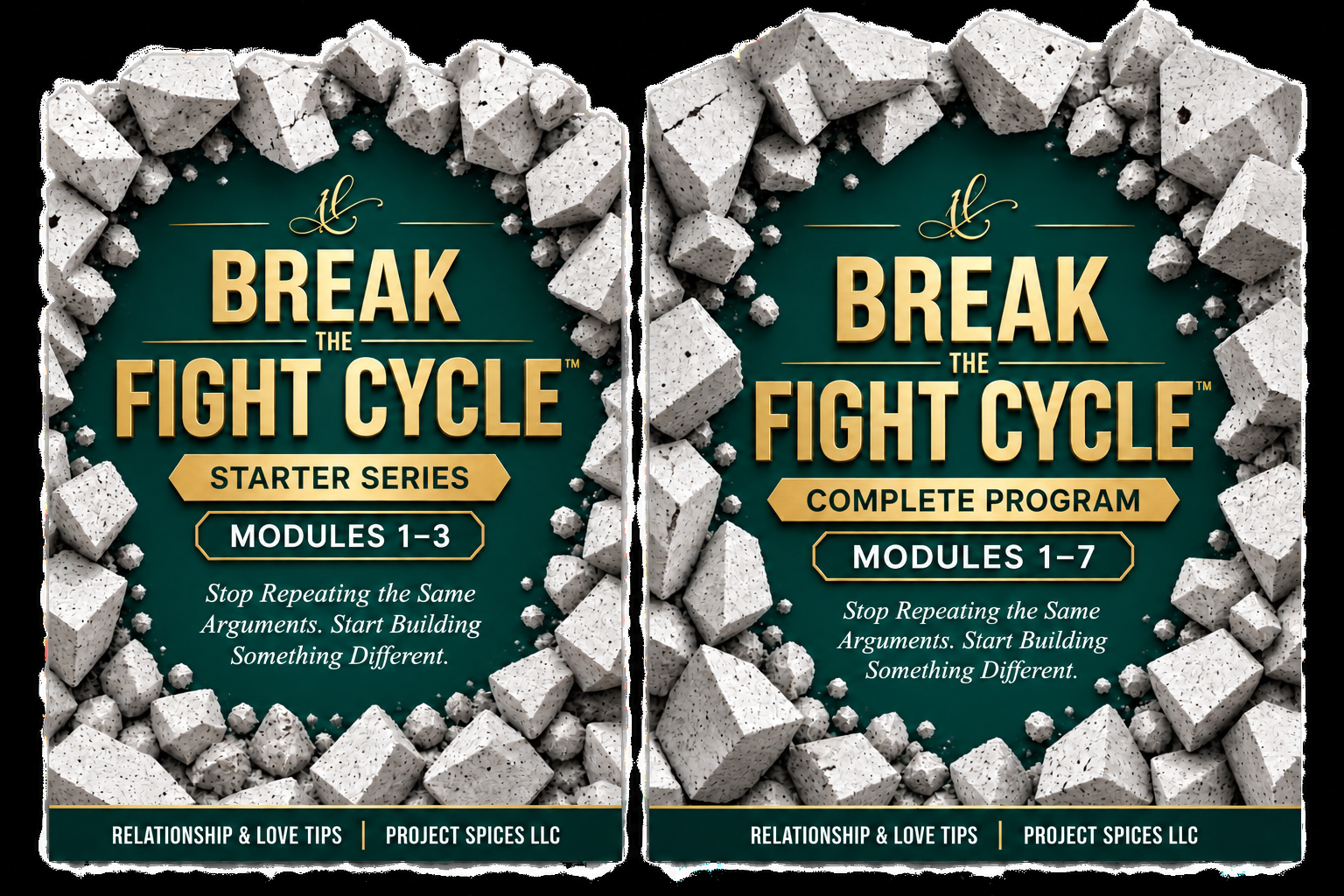
Break the Fight Cycle™ is designed to help people recognize recurring conflict patterns, notice escalation earlier and practice more deliberate responses when conversations become difficult.
 Click to explore →
Break the Fight Cycle™ is focused specifically on recurring conflict patterns.
Relationship & Love Tips™ provides the broader relational education pathway for communication, connection, trust, boundaries and practical relationship learning.
You do not need to understand the entire Project SPICES™ architecture before beginning with a relationship need.
The same argument seems to return even when the subject changes.
Difficult conversations escalate faster than either person intends.
One person wants immediate resolution while the other needs distance or time.
Communication feels harder under stress, transition or increased responsibility.
Trust, boundaries or connection have become recurring areas of strain.
You want practical relationship education rather than another collection of generic tips.
Project SPICES™ relational applications and Break the Fight Cycle™ provide educational, skills-based learning rather than clinical treatment.
Explore relationship learning →Individuals seeking personalized developmental support can explore the appropriate coaching pathway within the broader ecosystem.
Explore Coaching Specialty® →Therapy, crisis intervention, domestic-violence services and other clinical or safety needs require appropriately qualified professional support.
You do not need to diagnose the entire system before beginning. Start where the strain is most visible and choose the pathway that fits what you need.